
Corporate accounts
Corporate golf memberships & pre-paid rounds
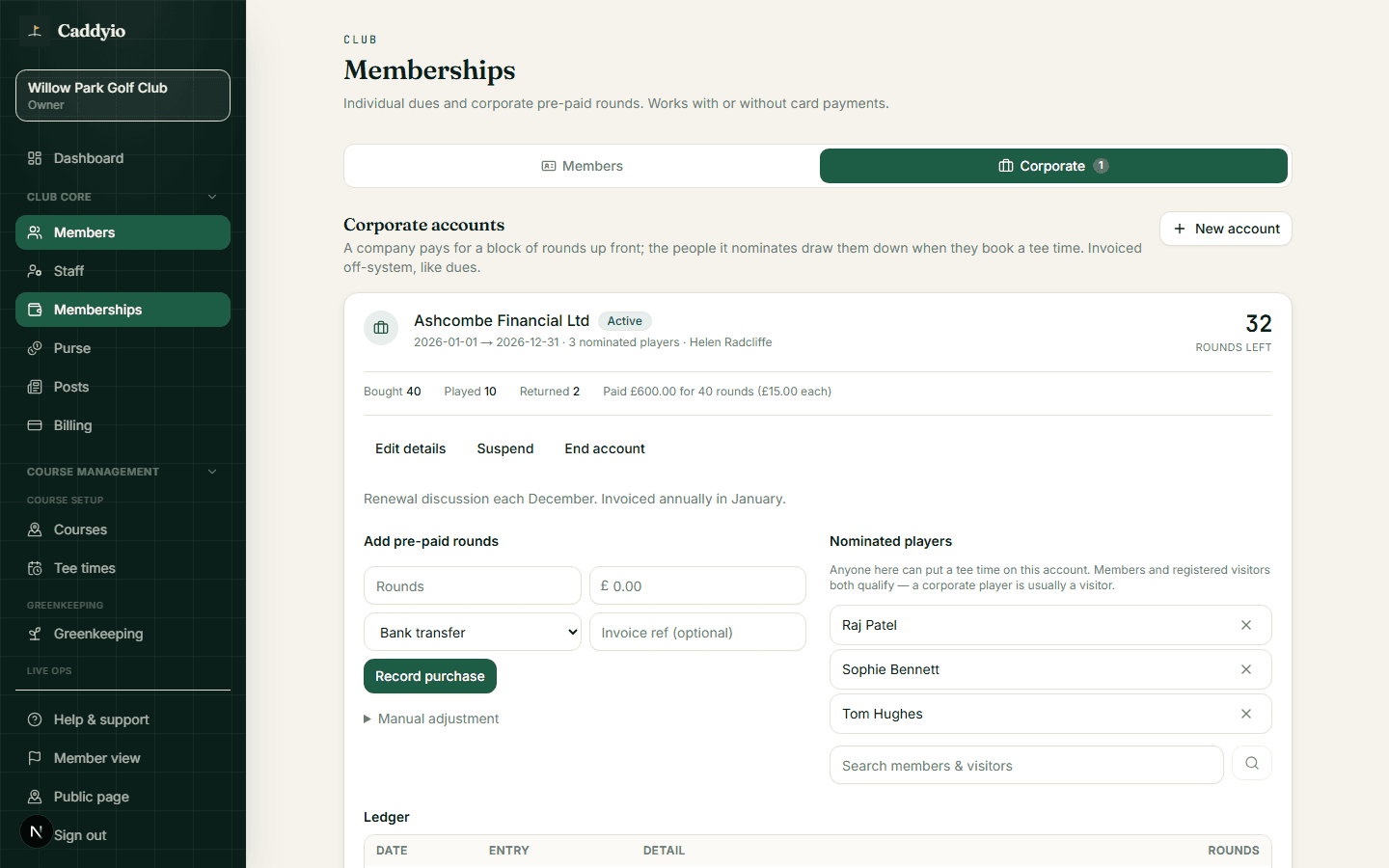
Corporate membership is one of the most reliable pieces of income a club has, and it's almost always run on a spreadsheet. Caddyio makes it a real product: a company pre-pays for a block of rounds covering the year, you nominate the people allowed to use them, and every round they book comes off the balance automatically.
The company's players get the same booking experience as everyone else — they just don't reach for a card, because their employer already paid.

The problem
The corporate deal is sold properly and then tracked badly
Forty rounds for the year, four named players, invoiced in January. By June nobody can say how many are left without counting entries in a diary, the pro shop waves people through because arguing is worse, and the renewal conversation starts with an argument about a number neither side can prove.
The response
A balance the club and the company can both see
Create the account, record what the company bought and paid, and nominate its players. When one of them books a tee time, the round comes off the balance there and then — and if the club declines the booking or the player cancels, the round goes straight back. Every movement is a line in a ledger nobody can quietly edit.
Why it matters
What a truly connected club gains
The number is never in dispute
The balance moves only when a round is actually bought, played, returned or corrected — and every one of those leaves a dated ledger entry naming the player and the booking. Renewal starts from a figure both sides can read, not a recollection.
Nobody has to remember to deduct anything
The draw-down happens when the player books, in the same step. There's no end-of-month reconciliation, no note passed to the office, and no round that quietly never got counted because the shop was busy.
Cancellations correct themselves
Rounds come off when a booking is requested — before the club has even approved it. If the club declines it or the player cancels, the rounds are handed straight back. A company is never charged for golf it didn't get.
New income without new admin
Corporate golf is the kind of revenue a club wants more of and dreads managing. When the tracking runs itself, selling the next package is a commercial decision rather than a question of whether anyone has capacity to administer it.
Pre-paid round balance
Record what a company bought and paid for. The remaining balance is the headline number on the account, and it can never go below zero.
Nominated players
Choose who may draw on the account — members and registered visitors alike, since corporate players usually aren't members.
Automatic draw-down
A nominated player's tee booking takes its rounds off the balance as it's made, and returns them if it's declined or cancelled.
For your club
- Sell corporate packages knowing the balance tracks itself
- See remaining rounds, rounds played and what the company paid, per account
- Suspend an account when an invoice goes unpaid without touching what's been bought
- Let pro-shop staff charge a walk-up booking to a company from the tee diary
- Keep a dated ledger of every purchase, round played, return and correction
For your members
- Book a tee time on your company's account without paying at the counter
- See the company name and rounds remaining before you book
- Get the rounds back automatically if the booking doesn't go ahead
- Use the same app and the same booking flow as everyone else
How it works
- 01
Create the account
Add the company, its contact and the period the allowance covers — a year, typically — then record the block of rounds it bought and what it paid.
- 02
Nominate the players
Add the people allowed to draw on it. Members and registered visitors both qualify, which matters because corporate players usually aren't members.
- 03
They book as normal
When a nominated player books a tee time, they're offered their company's account instead of paying, and the rounds come off the balance.
- 04
The ledger keeps up
Every purchase, round played, return and adjustment is a dated line on the account — ready for the renewal conversation.
The Caddyio difference
Corporate golf, run like a product instead of a favour
Because the account lives in the same platform as the tee sheet and the member app, the draw-down happens inside the booking rather than alongside it. There's no export, no reconciliation and no separate system for the club's corporate customers — and no incumbent club system treats corporate rounds as a first-class balance at all.
Compare the whole platformFrequently asked
- How does a company pay for its rounds?
- Off-system, the same way membership dues work: you invoice the company and record the payment — amount, method and reference — against the block of rounds it bought. Nothing about corporate accounts requires card payments to be switched on.
- What happens if a booking is cancelled?
- The rounds go straight back onto the balance, whether the club declined the request or the player cancelled it themselves, and the return is recorded in the ledger. A company is never left paying for golf it didn't get.
- Who can use a corporate account?
- Only the people the club nominates on it. They can be full members or registered visitors — corporate players are usually visitors, which is rather the point of the package.
- Can the pro shop charge a walk-up to a company?
- Yes. Staff adding a booking to the tee diary can charge it to a corporate account, so a company fourball that turns up on the day is handled at the counter and comes off the same balance.
- What if a company doesn't pay its invoice?
- Suspend the account. Its players can't book against it while it's suspended, but the rounds already bought are untouched and come back the moment you reactivate it.
Related features
All featuresTee times
Tee sheet & online tee-time booking
Run an online tee sheet members book from their phone, and manage the diary, blackouts and manual bookings from the clubhouse — all in one platform.
Learn moreMembership dues
Membership dues & subscriptions for golf clubs
Set membership plans and track dues without forcing card fees — record bank transfer, cash or standing order today; card via Stripe on request.
Learn moreMembership
Golf club membership management software
Manage members, onboard new ones with a club QR code, and give everyone a branded member area with proper staff roles. Members are always free.
Learn moreMember purse
Member purse & bar-card balances
Give members a prepaid club balance to top up and spend on the course — charge F&B to the purse, with staff top-ups and freeze controls.
Learn more